If you've tried everything and still can't
You answer the email. You smile in the meeting. Your voice doesn't shake.
And nobody — not one person in the room — knows your heart is slamming like you just ran for your life.
You've gotten good at this. Good at looking fine. And that's its own quiet fear: that one day you won't be able to hold the face on, and everyone will see what it actually costs you just to be here.
Or it's 3am, the thoughts won't stop sprinting, and you can't make them — or your own body — slow down.
And underneath all of it, the thought you'd never say out loud: what is wrong with me, that I can't just calm down when everyone else seems to?
Here's what no one tells you.
Everyone else didn't get a manual you missed. The calm tricks just fail in the one minute that actually matters — and you've spent years blaming yourself for a design flaw that was never yours.
Every "just breathe," every app, every "calm down" is built for the peaceful evening — the quiet window when you're already settled.
None of it is built for the spike window: the 90 seconds it actually happens, when you have no time and nowhere private to go.
Reaching for a calm-evening tool in that minute is like opening an umbrella after you're already soaked. And then it's easy to decide something's wrong with you.
It isn't.
Why the usual advice fails
You tried the breathing. You tried the apps. You tried "just calm down." None of it worked when it counted.
So we went looking — and the answer was simple. There's a whole industry that meets a 90-second panic with "just breathe," then bills you $70 a year for it. Every time it failed, it quietly let you believe you were the one who couldn't get it right.
Mid-spike your body's calm system is briefly hard to reach, so slow breathing often can't land — and for some people, breathing too hard can make a spike feel worse.
A library of 20-minute sessions for quiet evenings. Not much use at 3pm when the meeting starts.Most calm apps are barely opened a month after they're downloaded.
You don't need a device clipped to your neck. Your body already came with the switches.
The problem was never you.
It was the tool.
Sit with that, because you've been carrying the wrong sentence for years. You did the breathing. You downloaded the app. You told yourself to calm down. It didn't work — and you decided you were the broken one. You weren't. You were handed a calm-evening tool and sent into a 90-second emergency with it. When it failed, you took the blame that belonged to the tool.
The mechanism
Here's the part that resets everything. Mid-spike, slow breathing often can't land — your body's "calm" system is briefly hard to reach, and for some people breathing harder can even make it worse. It was the wrong switch — not the wrong you.
Because your nervous system has its own switches — through cold, through muscle, through where you point your attention, through movement — and they work while you're still keyed up.
The 5-Minute Reset —
your body's own override.
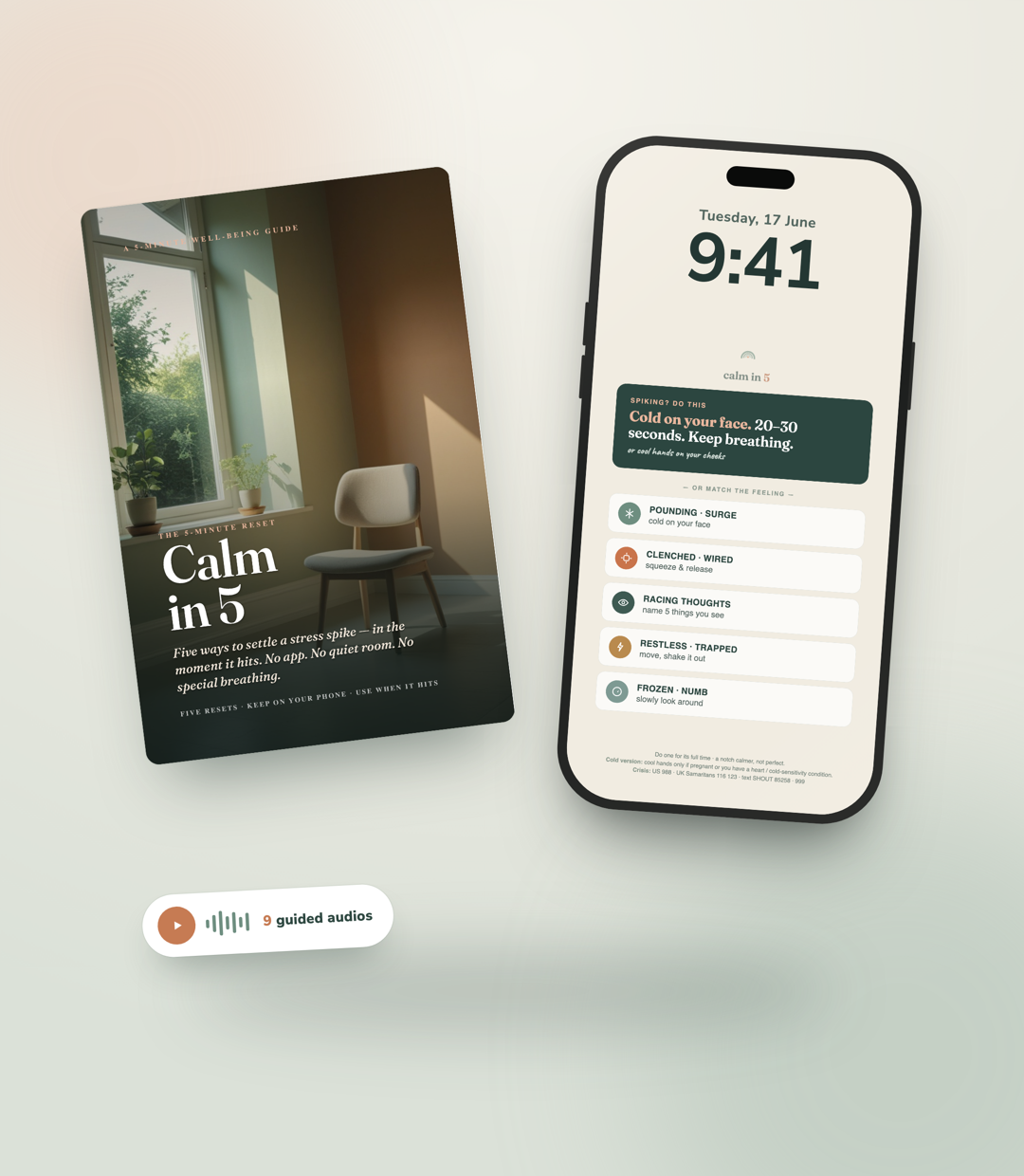
Five switches. One for each kind of spike. No breath gymnastics, no app, no gadget — just plain physical shortcuts that help bring you back into your own body, in the minute it counts.
(How much it helps varies from person to person.)
working with your nervous system, not against it
The five resets
No two spikes feel the same — so you carry a small set and match the reset to the moment. Several you can do at a desk, or in a meeting, with nobody noticing.
A fast physical nudge to the brake.
Drains the held tension feeding the alarm.
InvisiblePulls your focus out of the spiral.
SilentBurns off the fight-or-flight fuel.
The gentlest reset — it thaws the freeze.
GentlestEvery reset is drawn from widely-taught, non-proprietary well-being and nervous-system practices — cold and the vagal response, progressive muscle release, sensory grounding, movement, orienting. No gurus, no gadget, no subscription. Just the switches your body already has, organised for the moment you can't think straight.